TECHNICAL ANALYSIS OF CARTS
When we analyse carts from a technical point of view, it is surprising to notice that mobile-axle ox carts, which we call "Galician carts" even though we know that they were used for famwork and goods transport all over Europe throughout history, coexisted with fixed-axle carts for more than 3000 years.
Mobile-axle carts are more primitive than fixed-axle ones; they are stronger and not so fast, but easier to build. Their simplicity, their sturdiness, and the fact that they are so easy to build and repair, even for non skilled wood workers, are probably the reasons why this type of carts has survived in some areas throughout history.
In spite of their long evolution process, mobile-axle carts hardly vary in different places. Their fundamental elements: chedeiro and rodado, retain their functional characteristics.

THE CHEDEIRO, FORM AND STRUCTURE
 Rectangular chedeiros are typical of non-montainous, easily accessible coastal areas. Their structure, less resistant than the ogival one, has the advantage that its capacity is bigger because the surface of the deck is larger. The structure of square carts rests on the cabezalla; this piece reaches the rear side of the cart acting as the main support structure for the rest of the pieces that form the chedeiro.
Ogival chedeiros, with a great variety of forms, can be divided, from a functional point of view, into two groups: those in which the chedas and the cabezalla are one single piece, and those in which they are two separate pieces joined together at the brueiro. The second ones have the same functional characteristics as rectangular carts; actually, we can find many square-ogival chedeiros built this way.
Ogival chedeiros in which the cheda and the cabezalla are not separate are the most adaptable to hilly terrains because they are stiff and resistant. As a general rule, their capacity is inferior to the one of rectangular chedeiros. Due to their characteristics, they are also known as mountain carts.
In order to give one-piece ogival chedeiros their shape, the chedas were slowly bent with the help of fire. When they adopted the desired shape, they were put into bending moulds, where they were kept for one or two months so that they wouldn't unfold. Previously, the wood was often submerged in water for some time to improve its durability and make it easier to work.
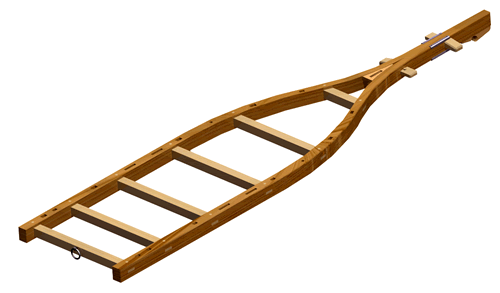
In carts in which the cabezalla and the deck were separate elements, there was a concentration of tension in the area where both pieces met; as a result, this was the part of the cart which needed a biggest reinforcement, as it could break easily.
From the point of view of the building process, rectangular carts can be considered an evolution of ogival carts, because their building was more complex, required more pieces and more assemblies, and in spite of this, they were not so strong and were designed for roads in good condition.
The structure of the chedeiro, in any of these cases, is completed by the cadeas, which, in ogival carts, are distributed in such a way that the ones at the back, where the chedeiro is wider, are closer together than the ones at the front, where it is narrower.
In the place where the axle is fitted, it is necessary to leave some space between the cadeas to assemble the treitoiras and apeladoiras. These pieces go through the chedas, that is why there has to be some distance between their fitting places and the cadeas. .
THE RODADO, AXLE AND WHEELS.
The chedeiros take multiple forms, but, for study purposes, we can divide them into two groups: ogival chedeiros and rectangular chedeiros.
Rectangular chedeiros are typical of non-montainous, easily accessible coastal areas. Their structure, less resistant than the ogival one, has the advantage that its capacity is bigger because the surface of the deck is larger. The structure of square carts rests on the cabezalla; this piece reaches the rear side of the cart acting as the main support structure for the rest of the pieces that form the chedeiro.
Ogival chedeiros, with a great variety of forms, can be divided, from a functional point of view, into two groups: those in which the chedas and the cabezalla are one single piece, and those in which they are two separate pieces joined together at the brueiro. The second ones have the same functional characteristics as rectangular carts; actually, we can find many square-ogival chedeiros built this way.
Ogival chedeiros in which the cheda and the cabezalla are not separate are the most adaptable to hilly terrains because they are stiff and resistant. As a general rule, their capacity is inferior to the one of rectangular chedeiros. Due to their characteristics, they are also known as mountain carts.
In order to give one-piece ogival chedeiros their shape, the chedas were slowly bent with the help of fire. When they adopted the desired shape, they were put into bending moulds, where they were kept for one or two months so that they wouldn't unfold. Previously, the wood was often submerged in water for some time to improve its durability and make it easier to work.
In carts in which the cabezalla and the deck were separate elements, there was a concentration of tension in the area where both pieces met; as a result, this was the part of the cart which needed a biggest reinforcement, as it could break easily.
From the point of view of the building process, rectangular carts can be considered an evolution of ogival carts, because their building was more complex, required more pieces and more assemblies, and in spite of this, they were not so strong and were designed for roads in good condition.
The structure of the chedeiro, in any of these cases, is completed by the cadeas, which, in ogival carts, are distributed in such a way that the ones at the back, where the chedeiro is wider, are closer together than the ones at the front, where it is narrower.
In the place where the axle is fitted, it is necessary to leave some space between the cadeas to assemble the treitoiras and apeladoiras. These pieces go through the chedas, that is why there has to be some distance between their fitting places and the cadeas. .
THE RODADO, AXLE AND WHEELS.
The rodado in mobile-axle carts is a group of pieces independent from the chedeiro. So much so, that the cart can be separated from the chedeiro just by raising it. In some manoeuvres there is even the risk of accidentally separating both sets of pieces. This is one of the reasons why carts do not have a safe braking system. If we transmitted force to the wheels to stop them while the animals kept pulling the cart, the chedeiro could separate from the rodado and cause an accident.
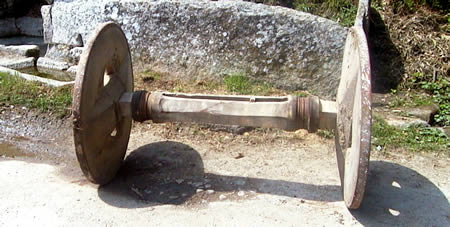
Both the axle and the chumaceira, the areas of the rodado where the chedeiro rests, suffer a great deal of wear and are the ones which require most attention and maintenance work. Among the support pieces, the rear treitoiras are the ones which work under the most demanding conditions. The animals' pulling force is transmitted from the chedeiro to the rodado through these pieces, so they had to be highly resistant to strain, bumping, and wear, and it was necessary to make sure that they were fitted with precision by means of the apeladoira.
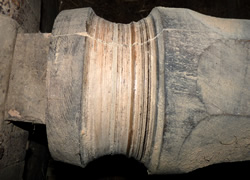
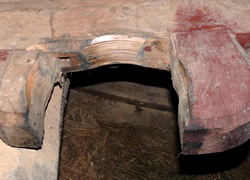
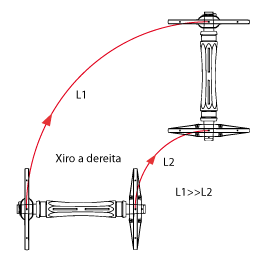
From a cinematic point of view, the fact that the wheels are assembled together with the axle and revolve together with it makes it difficult to turn and take bends. When they took a bend, the distance covered by the inside wheel is shorter than the one covered by the outside wheel; for this reason, the inside wheel should revolve more slowly than the outside one. In carts this is not possible because both wheels revolve together, so when they turn or take a bend the inside wheel skids and this results in a faulty performance The higher the speed and the sharper the turn, the worse this performance will be, and carts will even tend to turn over. Fixed-axle carts do not cause this problem as the wheels revolve independently. That is why this kind of carts progressively prevailed over mobile-axle carts, in spite that their building process was more complex.
Due to the kind of roads they had to travel and because of the difficult turnings they had to take, ox cart wheels were subject to great efforts, which is the reason why they are so sturdy. The most usual ones are those with a small empty space called ceo between the mión and the cambas. The better the condition of the roads they were supposed to travel, the bigger and lighter the wheels were made. Thus, in areas where the road networks were better, solid wheels evolved into spoke wheels.
In spite of being very strong and resistant, cart wheels used to break from time to time. For this reason cart owners used to have some spare wheels which were easy to change; they simply had to remove the polegar to take out the broken wheel and replace it with the other one, finally fitting the polegar back in its place.
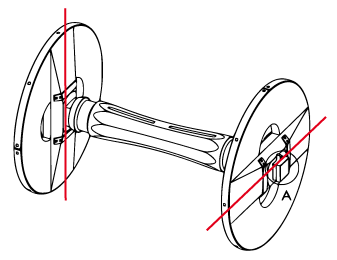
Cart wheels are assembled with perpendicular or alternate mións to prevent the wheels from failing at the same time. The wheel is less resistant when, taking a bend, the strain falls on the camba. When this happens to one of the wheels, the strain on the other one falls on the mión, which is much more resistant than the camba.
Both the axle and the chumaceira, the areas of the rodado where the chedeiro rests, suffer a great deal of wear and are the ones which require most attention and maintenance work. Among the support pieces, the rear treitoiras are the ones which work under the most demanding conditions. The animals' pulling force is transmitted from the chedeiro to the rodado through these pieces, so they had to be highly resistant to strain, bumping, and wear, and it was necessary to make sure that they were fitted with precision by means of the apeladoira.
From a cinematic point of view, the fact that the wheels are assembled together with the axle and revolve together with it makes it difficult to turn and take bends. When they took a bend, the distance covered by the inside wheel is shorter than the one covered by the outside wheel; for this reason, the inside wheel should revolve more slowly than the outside one. In carts this is not possible because both wheels revolve together, so when they turn or take a bend the inside wheel skids and this results in a faulty performance The higher the speed and the sharper the turn, the worse this performance will be, and carts will even tend to turn over. Fixed-axle carts do not cause this problem as the wheels revolve independently. That is why this kind of carts progressively prevailed over mobile-axle carts, in spite that their building process was more complex.
Due to the kind of roads they had to travel and because of the difficult turnings they had to take, ox cart wheels were subject to great efforts, which is the reason why they are so sturdy. The most usual ones are those with a small empty space called ceo between the mión and the cambas. The better the condition of the roads they were supposed to travel, the bigger and lighter the wheels were made. Thus, in areas where the road networks were better, solid wheels evolved into spoke wheels.
In spite of being very strong and resistant, cart wheels used to break from time to time. For this reason cart owners used to have some spare wheels which were easy to change; they simply had to remove the polegar to take out the broken wheel and replace it with the other one, finally fitting the polegar back in its place.
Cart wheels are assembled with perpendicular or alternate mións to prevent the wheels from failing at the same time. The wheel is less resistant when, taking a bend, the strain falls on the camba. When this happens to one of the wheels, the strain on the other one falls on the mión, which is much more resistant than the camba.