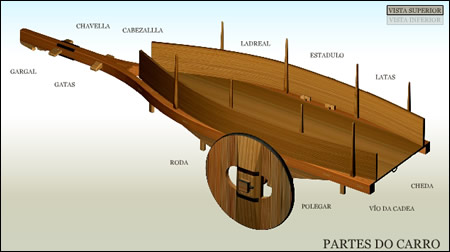
CART PARTS
Galician carts are made up of two clearly differenciated sets of components, the chedeiro, the platform were the load is laid, and the rodado, formed by the axle and the wheels. The most important parts of the chedeiro and the rodado are described below.
CHEDEIRO
Chedas: They are the sides that give carts their shape and on which the other parts of the chedeiro rest. Their shape varies in the different areas, which gave rising to different types of carts.
Cabezalla: The front part of the cart, into which the chavellas that are used to fasten the yoke are inserted. In some kinds of carts, the cabezalla is independent from the chedas whereas in other kinds it is a part of the same piece.
Cadeas: They are the crossbeams that link both chedas together and form with them the structure of the chedeiro. Their number may vary depending on the length and the sturdiness of the cart.
Latas: The structure formed by the chedas and the cadeas is covered by a number of planks called latas which form the floor of the cart.
Wheel bearings: They are in the lower part of the chedeiro, anchored on the chedas. They are the sets of pieces that support and guide the axle. They made up by the cloucón, treitoiras and apeladoira..
RODADO
Wheels: They are really solid; they are formed by three wooden pieces reinforced by iron pieces. They are connected to the axle by a coupling shaped like a square pyramid frustum, and they revolve together with it.
Axle: It is formed by one single piece. As it is mobile, it is one of the elements that differenciate carts from other means of transport. It must be very strong and resistant to wear. It is the piece that produces the carts' distinctive sound known as cantar do carro (the cart's singing).