ASSEMBLY SYSTEMS
The progressive utilization of iron to build carts took place as the use of this material became more and more popular due to the creation of forges in Galicia. Even so, it was not until the 20th century that iron was used to make assemblies, and it was added only as a reinforcing element to make some pieces, specially wheels, stronger. We are going to analyse the traditional assembly systems using wooden pieces and to give some examples of the incorporation of iron into assemblies.
CHEDAS ASSEMBLY
We have analysed the assemblies made for the building of ogival chedeiros, the most traditional and common ones in Galicia. Depending on the type of chedeiro that was being built, it was necessary to add different kinds of reinforcements or couplings between the chedas.
One-piece and two-piece chedeiros: in the chedeiros formed by one or two pieces it is necessary to include a reinforcement or a coupling in the cabezalla, where the chedas must stay together. The assembly is made by means of chavellas, which are used not only to attach the yoke to the cart but also to keep the chedas together. A rabbet is cut into the edge of the chavellas, and this rabbet, together with with an wood peg, ensures a tight fastening.
In modern carts, this system was either reinforced or replaced by an iron deck stuck to the upper part of the cabezalla or by two screws or stud bolts which went through the chedas.


The assembly of the chedas in their central and rear parts is made by the cadeas, although in the most modern carts we can find an iron brace that links the rear parts of the chedas together.
Three-piece chedeiros: Due to the availability of wood and the building techniques of the cart carpenters, the chedeiros were built with a cabezalla independent from the chedas. In this case, it was necessary to build a very strong assembly since there was a concentration of tension in the area where the chedas met the cabezalla, and this was the weakest part of the chedeiro. This assembly is called brueiro.
The most common solution consisted in reinforcing the area with two or more cadeas assembled in the same way as the rear part of the chedeiro, but closer together. Sometimes a chavella, a bit longer than the one in the cabezalla, was assembled to the narrowest part of the joint. Xaquín Lourenzo gave it the name of prixoá.
In the most modern carts, the union is reinforced with screws that go through the chedas and the cabezalla, and we can even find carts that incorporate fasteners.
This image shows three possible assembly systems recorded by Xaquín Lorenzo.

|

|

|
|
Cart of Velle. Assembly with two prixoás
|
Cart of Calvos. Assembly with a prixoá and a fastener |
Car of Oleas. Assembly made with two cadeas
|
ASSEMBLY OF CADEAS AND CHEDAS.
The cadeas are, together with the chedas, the pieces that form the structure of the chedeiro and give it the stiffness and resistance required for the work done by carts.
The union between the cadeas and the chedas is made by means of an outlet pin that comes out of the cadea and is stuck into the cheda. In order to fix their positions, a wooden peg goes through the cheda and the outlet pin mentioned when the cadea is assembled.

ASSEMBLY OF THE CLOUCÓN AND THE CHEDAS
This joint has to be very strong as it is through it that the strength of the animals pulling the chedeiro is transmitted to the axle which rests on the cloucón. The fact that the chedeiro and its load rests on the cloucón thus producing a great pressure between the latter and the chedas contributes to the strength of that assembly.
This adjustment is made by means of a simple assembly: two wood pegs on each side that go through the cloucón and the cheda are enough. The function of these pegs is reinforced by peóns stuck into the cloucóns. Although their main function is to work as hooks to tie the load up, they can be made a bit longer so that they go through the cloucón and reach the chedas, thus reinforcing the assembly.

ASSEMBLY OF THE TREITOIRAS AND APELADORIAS TO THE CHEDEIRO
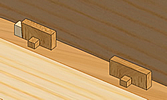 The treitoiras are the pieces that embrace the axle working as a guide and keeping it in its position. The pressure that the cloucón transmits to the axle through the treitoiras is extremely high. In order to do their work, these pieces go through the cloucón and the chedas coming out of the upper part of the chedeiro. The treitoiras must be fastened so that gravity does not make them fall. The most common system consists in using a wedge that rests on the latas and goes through them.
In order to assemble the treitoiras to the axle, it is necessary to add one or two wedges that are fixed lengthwise. They are called apeladoiras. It is advisable to fix the apeladoira somehow so as not to lose it if it comes loose as a result of the work of the cart. One of the most common ways to fasten the apeladoira is by means of a leather strip that joins the treitoira and the apeladoira together. These images show some assembly systems for the treitoiras and apeladoiras.

|
 |
 |
| Treitoiras of the cart of Terras of Bouro, Vilarinho da Furna (Designed by Fernando Galhano). |
Treitoiras of the cart of Montederramo. Cortesía da familia Crespo. |
System of treitoiras recorded in Vilamor, O Courel. |
WHELL ASSEMBLIES
Assembly of the mión and the camba
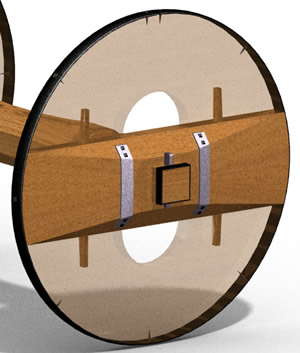 A cart wheel is formed by three wooden pieces: a mión and two cambas. The mión is the strong central piece to which the axle is coupled, the cambas are assembled on both sides of the mión to form the wheel. In most carts, they have a hole called ceo.
The assembly between the mión and the cambas is made by the relleiras and reinforced with the lamia. The relleiras are the most important parts of the wheels; they link together and reinforce the pieces that form them. They are approximately 60 cm long and they have a wedge-shaped end. Two relleiras are assembled to each wheel passing them through the mión and pressing them into the cambas.
The lamia is the iron plate that lines the wheel, protects it and acts as a clamp to reinforce the union between the cambas and the mión.
Assembly of axle and wheel

 The axle ends up in two square frustums on both sides, called ampenlas, which are fixed to the wheel. This assembly makes the axle and wheel revolt together. Thanks to it, carts become mobile-axle vehicles. In order to keep the wheel inserted into the axle, a wedge, called polegar, is added to the outer side. It goes through the axle and rests on the wheel preventing it from coming loose. In traditional carts, these wedges were made of wood and carts took one or two in each wheel; in modern carts these pieces are made of iron.