FUNCTIONS
FARM WORK
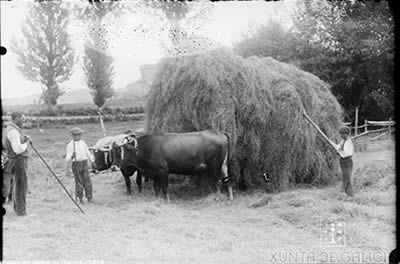
Kingdom of Galicia Historical Archives
|
Carts were mainly used for farming: to prepare the lands, to carry the materials needed for repairs, and to transport the crops to the barn or raised granary. Carts used to carry the gorse cut to make beds for the animals, carts loaded with manure came out of the stables to fertilize the lands where potatoes, corn, grapes for the wine harvest, cabbages and other vegetables for the family's self-consume were later sown. In the local contracts, the owners clearly specified the tasks that the tenants had to carry out in the rented vineyards and the amount of manure with which they had to be fertilized for higher productivity: "primeramente que lle roçasen enderedor o silveiro e mato.. que a ontre chantasen e que a estes chantamentos o encasamentos que lle deytasen tres carros desterco e pro cuanto non fora arrendada a cavasen toda en este mes de junio primeiro que ven sendo primeiramente rota de todo"1
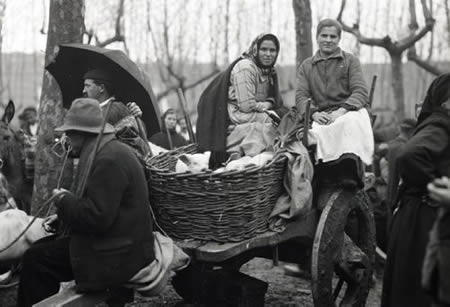
Ruth Anderson, M. Galicia in the 1920s |
A MEANS OF TRANSPORT
In a subsistence economy like the one in which Galician farmers lived, carts were an indispensable instrument for carrying out non-agricultural work for which the help and collaboration of neighbours were also required. Carrying stones from a quarry to build a stable, a barn, a raised granary or the family house was not easy. Transporting the largest and heaviest stones, such as a lintel for a barn or raised granary, from the quarry was especially difficult. For this reason, it was necessary to use the best yokes or to link two yokes together by means of a tamoucela. The same happened with the logs that, once they had been sawn in the oak groves, were used to to prepare the beams that bore the weight of attics and roofs in rural buildings. On the coast, carts made it possible to move shallow-water fishing boats, nets and other fishing tools to be repaired at home.
A UNIT OF MEASUREMENT

Gathering fishing nets in Vigo, 1927
https://picasaweb.google.com/blodopaco
|
TAXES
The nobility, who needed workers and means to build their medieval fortresses, did not hesitate to demand tributes and labour, which were not so common on other occasions.
ADDITIONAL FUNCTIONS
Apart from its utilization for farming and transport, the cart kept in the farmer's barn was often used for the pig slaughter. Following the slaughterman's instructions, men used to lift the pig up onto the chedeiro, the part of the cart that meets the cabezalla, which was previously raised by placing a wedge under one of the wheels so that the pig would bleed to death more easily. On the same cart, the pig skin, previously burnt with a tuft of straw, was washed and scrubbed. On the day of the slaughter, carts were also used as a shelf, and pork hams, shoulders, backbone, and lard were laid on the cart before they were taken to the larder.
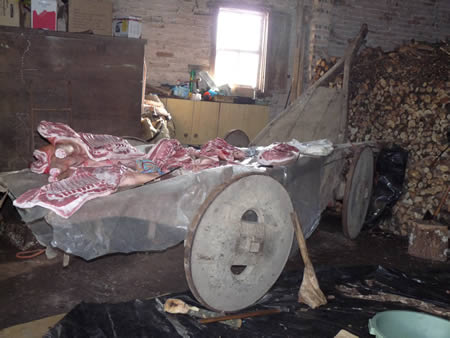
Pig slaughter on the chedeiro of the cart
Vidalén (Montederramo-Ourense)
|
1
CARRERA SÁNCHEZ, M. DEL CARMEN.
El Bajo Miño en el siglo XV. El espacio y
los hombres. Barrié de la Maza.
A Coruña, 1997. Páx. 83
2
SAAVEDRA, P. A
vida cotiá en Galicia de 1550-1580.
Biblioteca de Divulgación. Santiago de Compostela, 1992. Páx 96
3
SOTELO BLANCO, OLEGARIO.
Castro Caldelas y su comarca.
Ed Sotelo Blanco, 1981. Páx. 50
4
CARRERA SÁNCHEZ, M. DEL CARMEN.
El Bajo Miño en el siglo XV. El espacio y los hombres. Barrié de
la Maza.
A Coruña, 1997. Páx .87